I think lifelong learning is one of the key aspects of keeping your mind sharp. I'm not saying that you have to constantly audit classes at a university. But doing things as simple as reading—or, in my case, learning a new language at the ripe age of 44—is great for keeping the ol' grey matter in good shape.
The last time I formally studied a language was in college, where I took four quarters of Arabic. Arabic is a notoriously hard language, but I thought, “English is a hard language too; why not?”
What an idiot.
I didn't do well in Arabic, but I didn't do poorly either. I was just average. I hovered somewhere in the B-C range throughout those four quarters, but I was proud of those average grades because, like I said, Arabic is hard. I was mildly conversational at one point, but now? Now I can just read things that I don't understand. You want a cool party trick? Learn an alphabet completely unlike your own and wow people with your ability to read it out loud with ZERO comprehension of what you just said. Me so smart.
Fast-forward nearly twenty years, and we now have such an abundance of self-directed language learning software that I suffered a severe case of the paradox of choice. I eventually settled on two different software models to learn Spanish because the American way of life got the better of me: more is better, right? I landed on Duolingo as a free model and Babbel as a one-time paid subscription. Furthermore, I previewed several different software suites but landed on those two because I like to make random decisions with absolutely no logical reasoning.
Haha, that's not true. It follows my common theme of being cheap, and those were the best deals.
I have to give you some backstory here, as my poor wife gets quite weary of my constant shifting of interests and endeavors. She flat-out asked me, "Aren't you a little old to be learning Spanish?"
Yes. But I was going to do it anyway because I have Oppositional Defiance Disorder and, "You can't tell me what to do, Tina!" My wife fairly accused me of executing another whim that I would quickly lose interest in and subsequently quit. Well, joke's on you, Tina; I'm currently on a 223-day streak on Duo, baby! 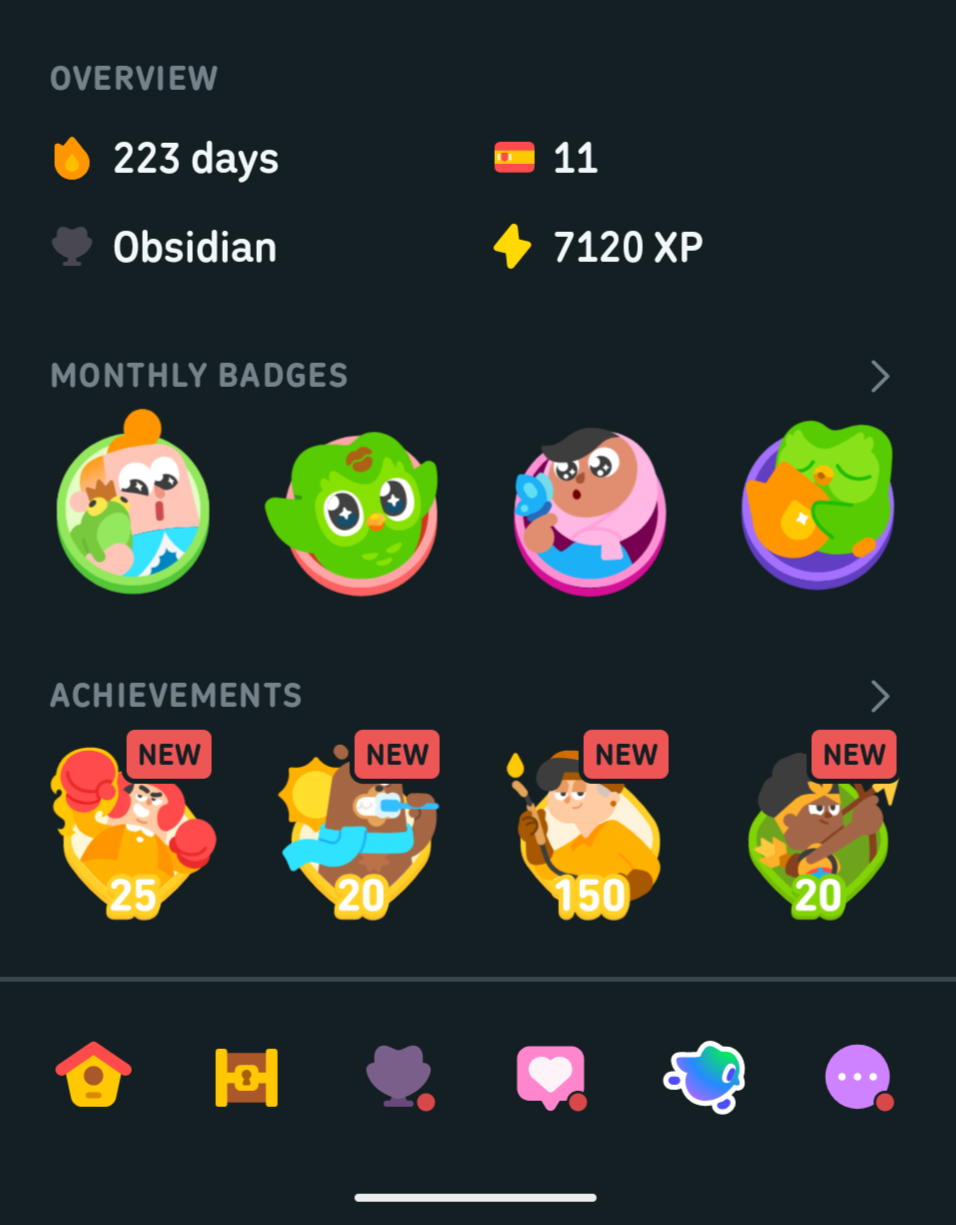 Haha, look at that!
You're probably asking what I've actually learned in my 223 days of consistent learning. Well, all kinds of things. I know where the closest mercado is and how to order tres cervezas. All very useful life skills. But I found one thing glaringly lacking in both pieces of software and in language learning as a whole:
Where are the curse words?
My wife is well-versed in the Spanish language, so I asked her to teach me some cussing. She didn't know any because they didn't teach that in the first grade. Bah! She also says I curse too much in my writing. That's horseshit.
I firmly believe that, when done correctly, cursing is one of the finest forms of communication. Sure, it's not fit for polite conversation, yet almost everyone I know curses in some form or fashion. I'm talking about even the most perceivably proper individuals letting out the occasional curse word when presented with the appropriate opportunity.
This led me to ponder, as I often do, a few things: Why don't teachers and software teach you a language's cursing, especially when it's so intrinsic to the culture? And why is cursing so damn satisfying?
There have been several theories regarding a correlation between cursing and increased intelligence, but as they say, correlation does not equal causation. From a purely scientific perspective, psychologists Timothy Jay and Kristin Jay note that increased cursing is actually a sign of verbal fluency, not necessarily intelligence. It follows an almost obvious pattern: the larger your overall vocabulary, the more curse words you'll know. That's fun, but what else can we glean from dropping an F-bomb?
Cursing is scientifically proven to lessen pain. This can be observed universally; when someone experiences a pain response, you can almost guarantee they're going to belch out an expletive.
- Ever stub your toe? "Shit!"
- Break a bone? "Fk!"
- Drop a hammer on your toe? "Damn it!"
According to researchers, letting out a solid curse word can lessen perceived pain by up to 33%. That's huge. What an astonishing benefit of the uneloquent. It also perfectly explains why I curse so much.
Unfortunately, I wasn't able to find any scientific data on why cursing isn't taught in traditional learning, but people have numerous opinions on the matter. In summary, it boils down to being "polite." Perceivably foul language could offend someone's more delicate senses in a classroom environment and is therefore omitted.
Poppycock! Words, no matter how offensive, are still part of a language and should be taught to unsuspecting learners. That way, they aren't caught off guard when they inevitably butcher the dialect in front of a native speaker and are appropriately insulted.
I'm not sure that we've actually learned anything useful through this exercise, but I do know a few things. I'm going to continue to curse because I like to be pain-free, and I'm going to learn how to curse in foreign languages because I want to know if someone is insulting me. Furthermore, I would like to know this so I can politely congratulate them on their expansive verbal fluency. Additionally, it's important to know these words so people know when you're in pain while visiting far-off lands. How else would they know that you need el hospital?
My fatherly advice for the day is to continue to learn new things throughout your life. It will often take you to interesting places and introduce you to interesting people whom you can offend in exciting new ways. I encourage my girls to explore and learn new things daily, but they usually ignore me, so I get to tell you instead.
Padre fuera.