Have you ever had a problem with communication? I'm not talking about programming a SINCGARS radio (any military folk out there will appreciate that). I'm talking about communicating with other people. You would think in the age of connectivity we would be effective communicators because there are so many ways to do so, but that's not the case. If anything, I think we have societally become less effective at this. At least, I have.
The Curly Cord Era
When I was a kid, every house had a landline. You had to memorize the phone numbers of people you actually wanted to talk to or comb through the white pages hoping to find the right one. For much of my youth there was no caller ID, so answering the phone was like playing the lottery. You weren't sure if you were going to win by having the call be for you or if it was Columbia House demanding payment on the CDs you "forgot" to pay for because you were 12.
Talking on the phone was also like being confined to quarters since you could only move as far as that curly pigtail of a cord would allow. This yielded some prolifically long cords, providing the opportunity to traverse the entire house while wrapping it in wire like a Ukrainian battlefield.
I've mentioned before that I'm a geriatric millennial or the last remnant of Gen X, which puts me squarely in the category of Xennial. I was born in the transition years, and people in this demographic witnessed firsthand how technology changed to shape the world we have today.
Dial-Up and Ditch Survival
My generation witnessed the rise of the Internet! We also didn't have affordable cell phones during our formative years; plus, who would want to carry a satchel phone anyway? So we either called our parents from a payphone (What's that?!) or they were left to wonder if we were "dead in a ditch somewhere." Only a few kids out of the millions growing up in this era actually ended up dead in a ditch, but it wasn't nearly as frequent as our parents made us believe. Ha, Mom! I didn't die in a ditch!
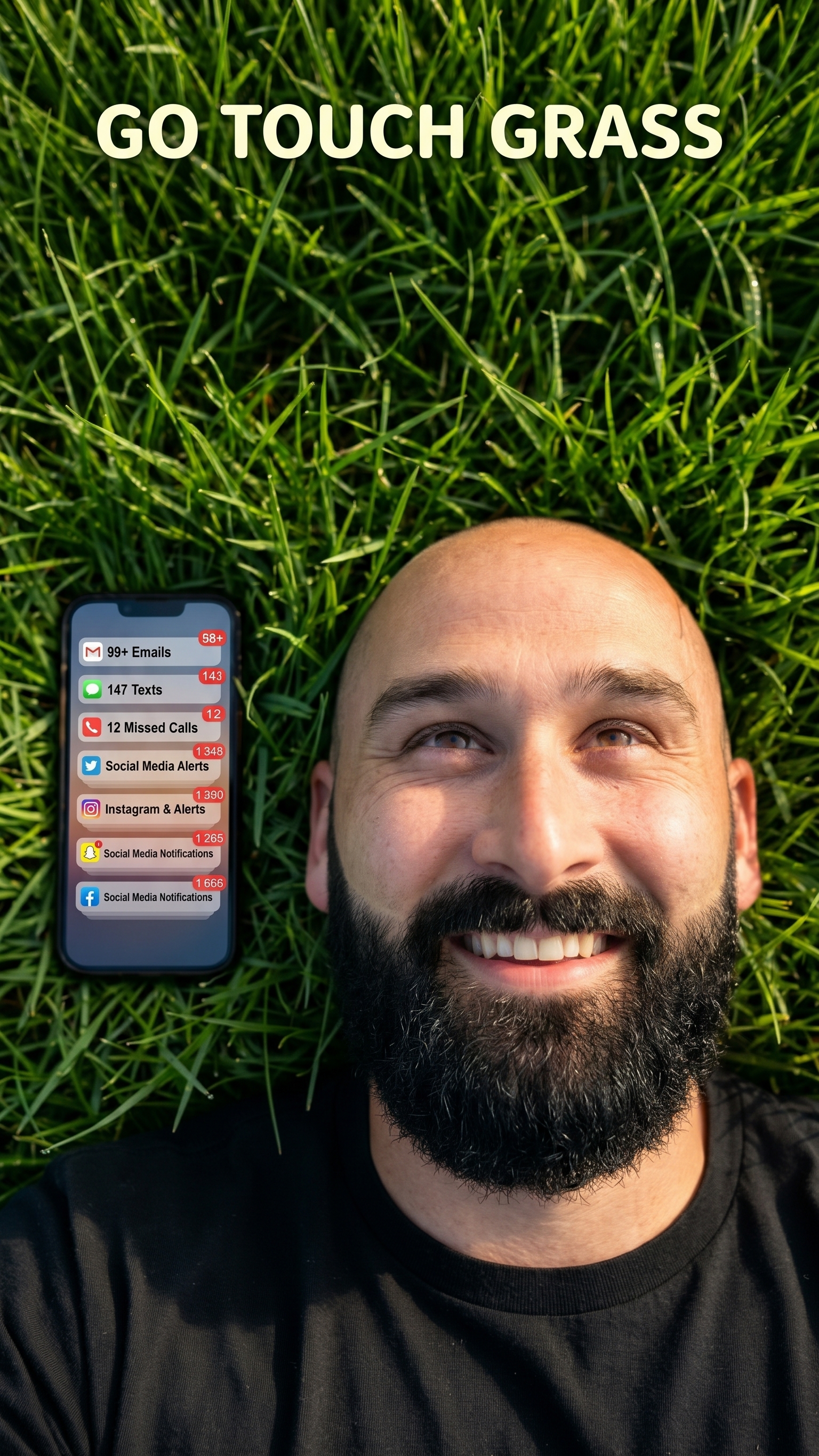
Since cell phones were barely entering the mainstream, AOL compensated by giving us AIM (AOL Instant Messenger). As a teenage boy with an active social life, this was remarkable. I could have full conversations with girls and friends for as long as my dial-up Internet would hold out, AND at one point you could even create group chats. Again, this form of communication required you to be mostly stationary, limiting your mobility, which would oftentimes force you to take a break and go touch grass.
I might be overstating it, but I believe these fixed lines of communication ended up being a good thing. You weren't able to take people with you during a conversation like you can today. Having a delineated time and a fixed place naturally abbreviated these conversations, motivating you to get off the phone and actually see the people you were talking to... or not, if you didn't really want to interact with them anyway. We did occasionally have prolonged conversations, but usually it was a preamble to a physical meeting.
The "I Don't Care" Conundrum
Today, we communicate through abbreviated messages, emojis, and hilarious GIFs while continuing the daily grind of life. There is no more pre to our amble. We communicate out of convenience instead of an actual or perceived need. When we do see each other in real life, it takes time to knock the rust off after not being around actual people for weeks or, God forbid, months at a time.
I used to be excellent at interacting with people despite my probable neurodivergence. Today, I find myself becoming more and more awkward around others, and I've noticed many of my friends fitting into the same category. It's not that we're unable to have effective conversations; it's just that we're out of practice because the vast majority of our interactions take place through a screen.
This entire post was precipitated by my wife getting frustrated with me recently for failing to have a dialogue.
I don't recall what this supposed ghost dialogue was about, but it usually involves gathering my perspective on logistics for us or our children. Her main valid complaint is that I don't often invest considerate thought into the conversation, or I exhibit a lack of care for the topic. Her frustrations aren't unwarranted because in the moment I know that's exactly how I'm being perceived.
When she asks me "What do you think?" about something, I can imagine my typical response of "I don't care" runs counter to her desire for an actual dialogue.
In my defense, I typically say exactly what I'm thinking, so when I say "I don't care," I mean it literally. There are some things I just don't have a strong opinion on. But this led me to reflect. Maybe she's not looking for a specific answer, but just a genuine conversation outside the abbreviated texts and thumbs-up emojis we exchange when we're apart. Dare I say, she wants a connection.
Tiny Sponges and Touching Grass
Technology has been wonderful for so many reasons, connecting people across vast distances, but it comes with pitfalls. The ability to choose our responses based on our own timeline has diminished our ability to effectively communicate face-to-face. Interacting in person requires dedicating brain power to actually carrying a conversation, instead of just bouncing digital responses back and forth like a slow game of Pong. This skill is even more important today, especially as I've been seeing signs of difficult interactions involving our kids.
I know it's probably normal, but I don't want to continuously coax my children into reciprocating a simple "hi" or "bye" just to keep them from staring back in utter silence. I can't imagine what small talk in their formative years will look like without continued intervention. So for this reason, it's important to talk. Just talk.
Not only should we have real conversations with our kids, but we need to put them in situations where they have to interact with others. Modeling this behavior is crucial because those tiny sponges are always watching... always. If they see Mom and Dad delving into the trenches of real social encounters and thoughtful chit-chat, it will eventually rub off on them. It seems the phrase the kids are using today, "go touch grass," holds a modicum of truth.
Go out, talk to people, and put the phones down. Put in some effort to make meaningful connections because that's what life is about. The relationships I still have today have lasted because all parties put in the effort to maintain them, and that's not done through the odd text. It's done by coming together and having a dialogue. It's worth the effort.
As always, thanks for reading.
Dad out... to go touch grass.