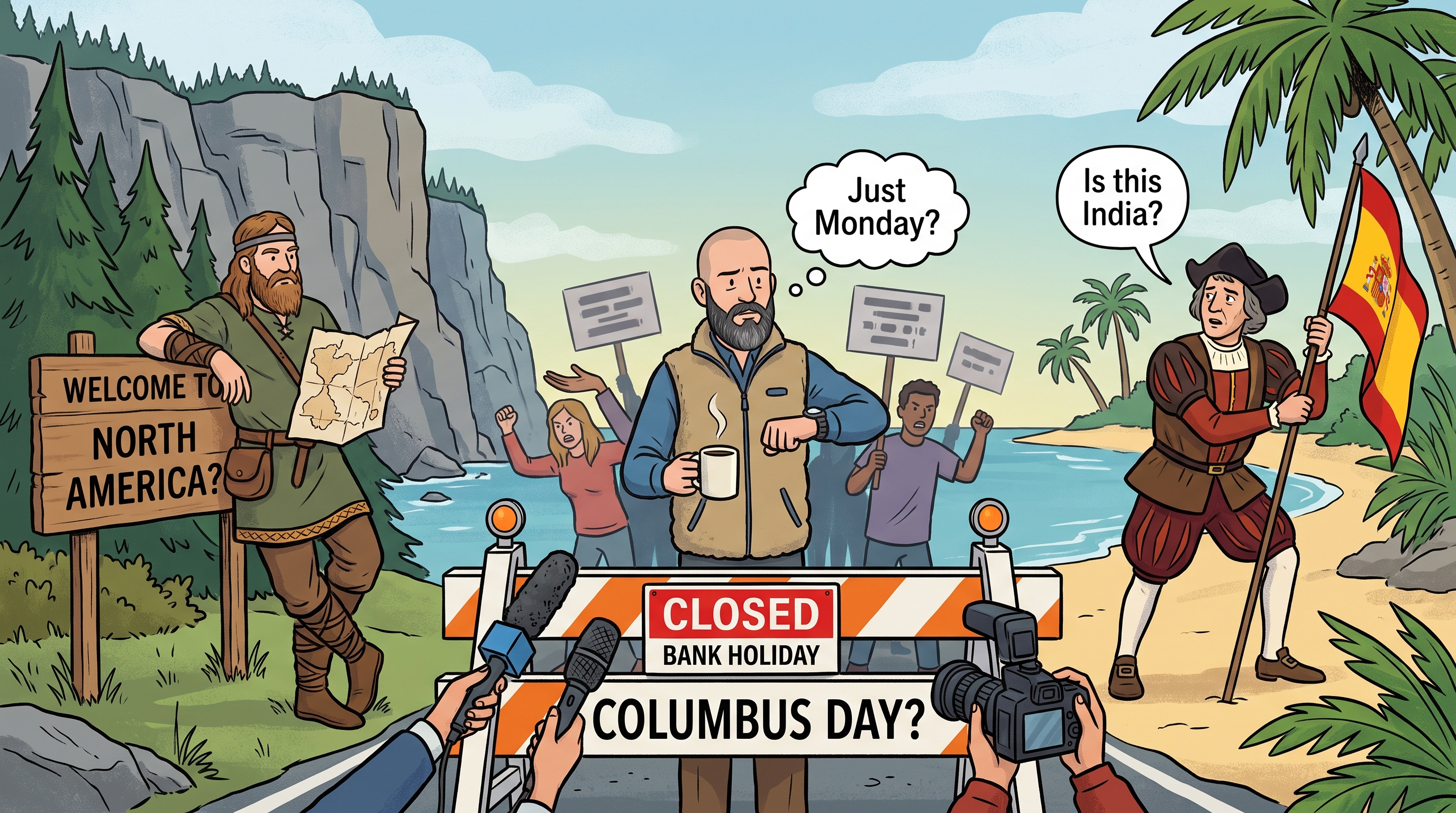
"In fourteen hundred and ninety-two, Columbus sailed the ocean blue." Columbus is so lauded here in America that we even have an Army cadence about him, "Columbo" (not the show). Today, there is a movement claiming that Columbus was a giant asshole and should've sailed himself straight home. Further, as I write this, it is Columbus Day yet again in a city that holds his namesake. It's a federal holiday that people mostly didn't care about until they did, meaning some politicians needed to get people worked up over nothing.
I'm not sure if I'm supposed to call it Columbus Day, Indigenous People's Day, or just Monday. There seem to be some hot-blooded opinions on this innocuous holiday, and the national temperature on it shifts about as often as the wind... Or the presidency. So why do people love to hate or hate to love Columbus? Wasn't he just some weirdo that wanted to sail to India? And was he really the first person to discover America?
I think in order to put this to rest, we need to figure out who the first European was that "discovered" the Americas. I say European because, you know, people already lived here, and if you weren't white at the time, you didn't count.
If You're Not First, You're Last
Again, despite the indigenous people who already inhabited this sprawling land, Columbus wasn't the first European to set foot in the Americas. In reality, Columbus didn't even make it to North America. What?! Isn't he supposed to have been the great discoverer of the United States? The furthest this dude ever made it was Venezuela (along with the Caribbean and Central America), and they're doing soooo well today, so yeah, thanks, Columbus. The first European to land in North America was Viking explorer Leif Ericson. He achieved this approximately 500 years before Columbus and landed in Newfoundland, Canada, where they established a settlement.
Not only did Leif have a badass Viking name, so did his father, Erik the Red. Come on! Leif Erikson Day has a much better ring to it than Columbus Day. Anyway, the accounts of Erikson finding Vinland, which is speculated to be North America, differ from saga to saga, but one fact remains: there are the remains of a Viking settlement in Newfoundland, named today as L'Anse aux Meadows, dating back about 1000 years.
Wait, Columbus wasn't first!?! So why do we even care about Christopher Columbus? Why aren't we celebrating Leif Ericson Day and setting up and subsequently tearing down statues of the actual, first European to touch down on the land of freedom and bald eagles? Much like your first major breakup, "It's complicated."
Politics Ruin Everything
Whoever said that the Internet is only filled with porn, cat memes, and TikTok videos is wrong! I asked the Internet why we celebrate Columbus Day and not Leif Erikson Day; it actually taught me something new. Let's examine Columbus, first.
The initial push for Columbus Day started in the late 19th century and endured through the early 20th. The reason for this push remains prescient in today's political environment; it started with a persecuted class of "foreigners", the Italians. At that point in American history, Italian immigrants were frowned upon as being slightly olive-skinned, dirty criminals sucking up jobs and stealing from good Americans (whatever that turn of phrase is supposed to mean). This tension boiled over in 1891 when a mob lynched 11 Italian immigrants in New Orleans, nearly starting a war with Italy. If this xenophobia doesn't sound familiar, I can't help you.
To garner public support, cool the diplomatic tensions, and build sympathy for America's growing Italian population, certain groups decided to promote the achievements of our most famous Italian explorer, Chris Columbus. With the aid of the Catholic Church and the Knights of Columbus, this effort yielded results in the form of Columbus Day, which became a permanent federal holiday in 1937.
I think it's important to note that we don't have Columbus Day because he supposedly discovered America. We have Columbus Day because an ethnic group was being persecuted through policy, rhetoric, and violence. I think this distinction may garner a little more understanding of Columbus Day's relevance today, considering detractors focus solely on the atrocities committed by ol' Columbo and not necessarily the reason for the holiday to begin with. I think that matters.
I also believe it's important to note why Columbus probably wasn't the best choice of an Italian icon regardless of the reason. He was kind of a piece of shit. OK, not "kind of," he was a massive POS. He started the slave trade in the Caribbean and was accused of heinous acts of mutilation, rape, and just being an all-around horrible human being. I think the key distinction is that this wasn't even normal for the time.
There was a Spanish inquiry conducted, and the Crown found his actions to be so offensive that he and his brother were brought back to Spain, in disgrace, and subsequently imprisoned. When the source of the Spanish Inquisition says, "Hey bro, you crossed a line," you have to acknowledge that Columbus probably sucked pretty hard.
So what's the deal with Leif and Vinland (land of wine, heck yeah!)? Was he just as big a turd as Columbus? While the Norse sagas do record that Leif's crew and later Viking expeditions had violent clashes with the indigenous population, their footprint was tiny and short-lived. The dude just landed on a new continent, established a colony, eventually left and died where he came from, Greenland. No harm, no foul, Leif. I think it's also important to note that future Viking explorers did indeed brutalize indigenous populations after establishing what could be described as friendly relations... But we're talking about Leif here, and if the glove don't fit...well you know the rest.
So where does that leave us today?
To Statue or Not to Statue
Every year in recent history we face the question of continuing to memorialize a giant POS through erected statues and a federal holiday. Should Americans actually be celebrating a man who arguably started the atrocity of slavery in the Americas and brutally raped and murdered untold amounts of people? This broaches the argument of erasing history. Many proponents take the position that regardless of his sordid past, Columbus was the catalyst of what we have today and shouldn't be "cancelled." There is also the sentiment that history is simply that—history—and we should embrace all of it, warts and all.
On the flipside. Most people don't hold the belief that certain parts of history should be erased; it just shouldn't be celebrated. I suppose one way of looking at this is that Germany doesn't have erected statues of Adolf Hitler, nor do they have a national holiday celebrating him. They require education about World War II so they, hopefully, don't make the mistakes of the past.
I, personally, hold to the latter sentiment: if individuals of the past were wholly rotten, we don't need to put them on a pedestal. It's really not a hard concept. But the truth is, the holiday itself doesn't actually matter. The collective, feigned rage over 'canceling' Columbus is nothing but political pearl-clutching. It's a cheap way to manufacture division while we ignore the massive, immediate problems sitting right in front of us. Our culture loves to fight over ghosts instead of fixing the present. Take the statue down, leave it up, call the day whatever you want—just don't pretend it's the most important thing happening in the country right now.
Dad out.