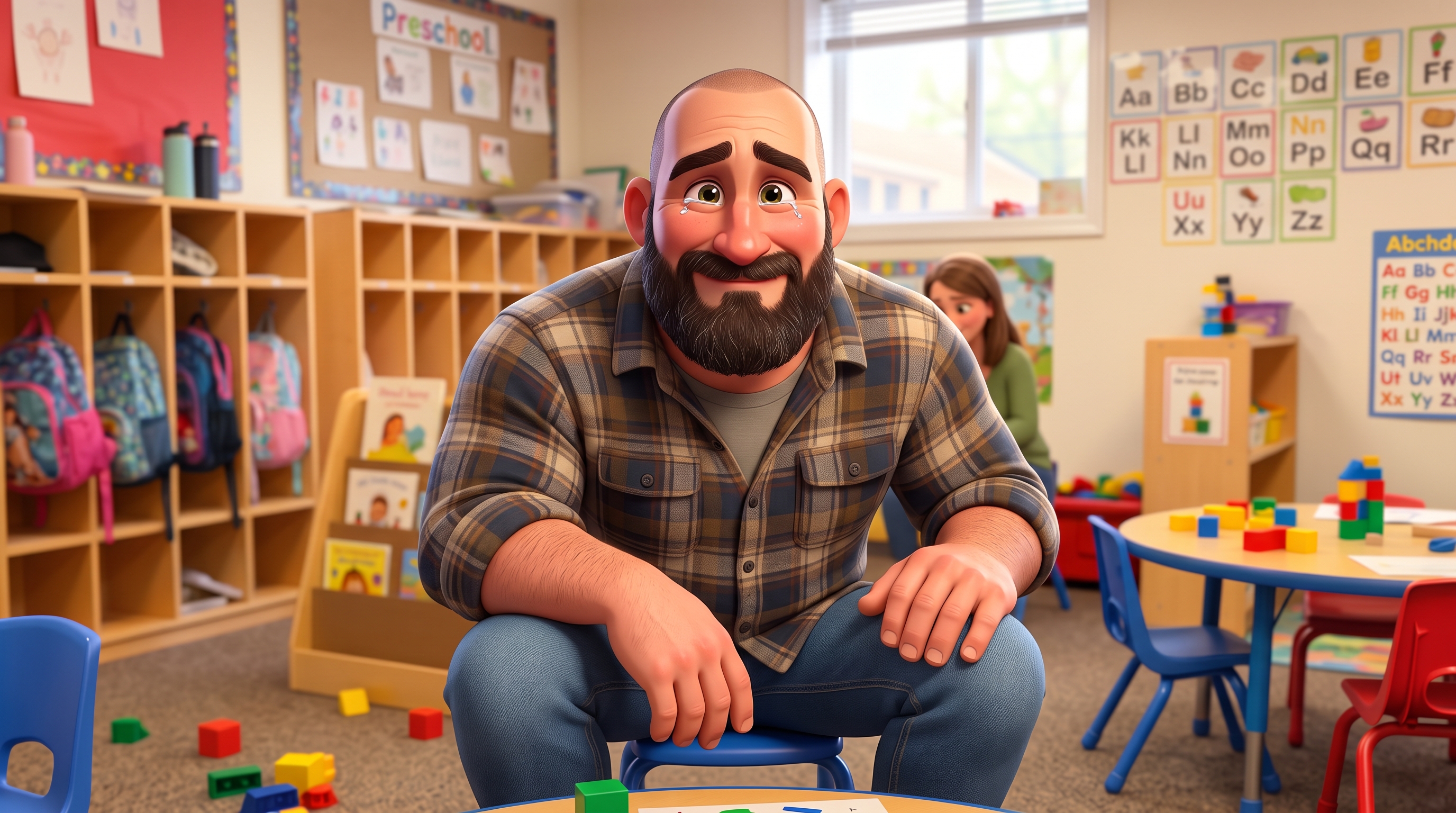
I’m excited to report that we’ve entered that time of year again, where I walk into a school and instantly become a ghost. If you have no idea what I’m talking about and think I’m absolutely off my rocker, go read my previous article, Ghost Dad. But this year… this is my year! That’s right: in each one of my kids' conferences, I wasn’t outright ignored. In fact, during my oldest daughter's conference, I was actually addressed in equal measure! Yes! I’m a real boy!
Now that we’ve established I am becoming corporeal in schools again, I suppose I should get to the point: school conferences for a special needs kid are hard.
This probably doesn’t apply to the vast majority of people not reading my blog, but for those who are, feel free to nod along, break out the occasional, “Yasss, girl!” and snap those fingers like a firecracker.
Not to belabor the point, but my youngest daughter is profoundly autistic with a global developmental delay. Practically, that means she’s well behind her peers across all facets of development. She’s five years old, isn’t potty trained, doesn’t speak more than a few words, and is low-tone. This means she is super floppy and struggles to control her body appropriately. She also has the attention span of a gnat, so she historically doesn’t want to stick with any single task for more than a few seconds. She’s wonderful. She’s exhausting. She’s ours.
Because of this, she has been in an early intervention program since she was two. So, we have been having conferences about her for four years now, and she’s only five. I know this doesn’t seem like a big deal, and I’m not ignorant to the fact that many families have kids with even more intense challenges. But we aren’t other families. This is our lived experience. And in our experience, school conferences had become an object of dread.
Hunting the Good Stuff
When I was in the Army, we had a program aptly named Army Resiliency Training (ART). This program was designed to teach Soldiers medically sound coping mechanisms for dealing with the intense stresses of military life. In reality, they aimed to keep us from killing ourselves so frequently. One of the foundational pillars of this curriculum was the concept of Hunt the Good Stuff. This idea challenges you to change your mindset by shifting away from dwelling on all the negative aspects of your life and instead actively searching for the good.
This concept has personally stuck with me for years. Having a bad day? What was something good that happened? I can guarantee that you can find some glimmer of good in any situation or challenging season of your life. Eventually, this constant practice changes your mindset from one of victimhood to one of resilience. You become a glass-half-full type of person. It’s not easy, but it is definitely achievable.
This is relevant today because our youngest daughter’s teachers REALLY have to hunt for some good stuff. And sometimes, so do we.
An Atypical Experience
Our oldest daughter is what you would call a typical kid. She meets all of her milestones right when, or even before, she’s supposed to. She excels in certain subjects and is average in others. Beyond that, she’s happy, kind, smart, and an all-around great kid. We don’t dread going to her conferences, even though she’s reaching the age where us talking to her teacher makes her "nervous." Ha! She’s a typical kid.
Our youngest is definitely atypical, as I’ve already outlined. When we go to her conferences, we have to schedule meetings with at least three different people. She receives practically every service available, including speech, occupational therapy, and physical therapy, on top of spending the day with an intervention specialist. So when we schedule conferences for her, we have to carefully line up every meeting consecutively so we don’t prolong the entire experience.
I have to be transparent in saying that I don’t particularly enjoy going to these meetings. Historically, she’s shown minimal progress on paper, and when her sweet teachers try to list her positives (teachers are exceptionally good at hunting the good stuff), we get the same response across the board: “She is such a sweet and happy girl! We just love having her!”
We appreciate this sentiment, we really do. But it doesn’t make the rest of her perceived shortcomings any easier to digest. The kicker is that they always offer an "equivalent age" associated with her current functional level, and in most instances, it’s significantly lower than her actual age. Imagine having a professional tell you that your five-year-old is operating at the level of a two-year-old, or below, in many observable fields. It doesn’t feel great.
But...
Here’s the real kicker. We see more potential in her than anyone else. I think that’s for two reasons. First, she simply doesn’t show the same level of ability at school that she does at home. We often hear about tasks that she easily completes in our living room being entirely absent at school. Second, without knowing her well, she presents as a child who functions at a much lower level than her actual cognition. We’re not ignorant to the fact that teachers and staff can only report on what they observe, but that doesn’t make it any less frustrating for us as parents who know her potential is so much greater than what’s printed on a piece of paper.
Yesterday, all of that changed.
Leaps
There is a term widely used to describe when children blow past a developmental milestone and suddenly gain new abilities: a leap. We went into our girl’s conference yesterday with the same expectations we’ve grown accustomed to: low. It’s not that we’ve given up hope; it’s just that we’ve been hearing the exact same things for years. We had zero expectation of hearing anything different, even though we’ve been seeing great strides at home.
Well, we were pleasantly surprised.
Her intervention specialist informed us of how much she has started to “come out of her shell” and actively engage in most aspects of classroom activities. She’s showing marked progress! This wasn’t exclusive to just her classroom behavior but, more importantly for us, it was evident in her communication and perceived cognition. It was wonderful and, to be honest, incredibly surprising to hear that she’s finally starting to show everyone else what we’ve known all along. She’s capable, and she's smarter than some have given her credit for.
In full transparency, it made me tear up a little. For the record, NO actual tears were shed. After all, I have to maintain my image as a bearded, barrel-chested freedom fighter. But man, that entire experience got me right in the feels.
I’m sharing this to offer a small modicum of hope to every other parent who has harbored legitimate fears for their children. It doesn’t matter how small or seemingly insignificant your concerns are; we all just want what’s best for our kids. I think this is precisely why it’s so important to hunt the good stuff in their lives. Just because they aren’t meeting the rigid expectations set by a system or a stranger doesn’t mean they aren’t capable of living a happy, fulfilled life.
We know our kids better than anyone else, and I challenge every parent out there to constantly advocate for your children. Being a champion for your kids will absolutely come with bumps along the way, but I guarantee that staying the course will reap rewards… even if they’re a little atypical.
Thanks for reading, and keep hunting the good stuff.
Dad out.