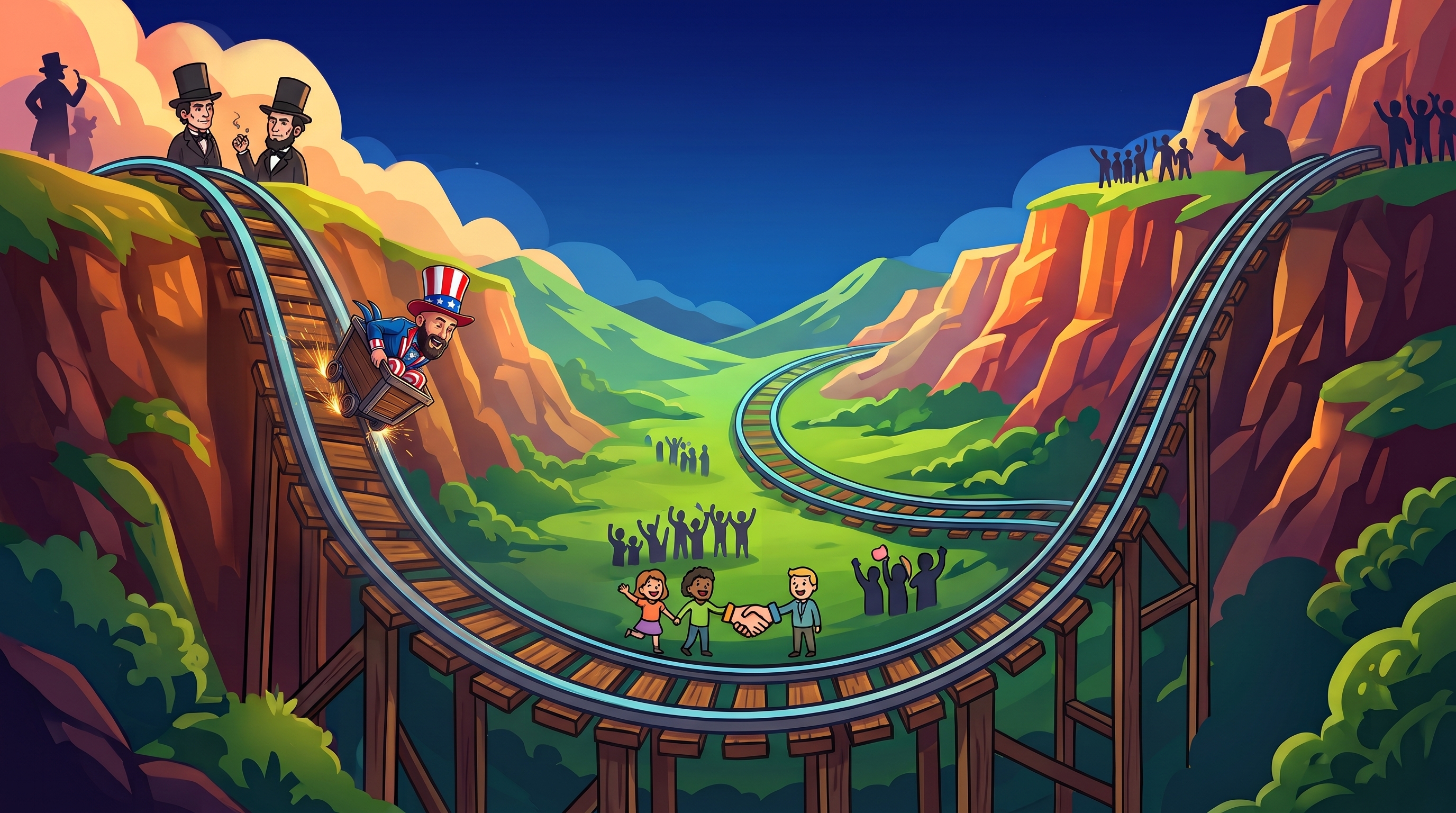
 ’Tis the season for political pieces! In today's divisive political climate, I often hear the phrase, "We need a return to civility," uttered by all types of people when addressing the woes of today's landscape. While I wholeheartedly agree with this thought, I wanted to dive into the data to see where we would actually be returning. Has American politics ever really been civil? Also, what is the metric for civility? What I found was much less straightforward than I had hoped, and I found that America isn't, nor has it always been, polite when it comes to our ideologies.
A U-Shaped Timeline of Naughty and Nice
I won't say the results from my query were surprising, but they were interesting. I built this study off four objective measures of civility. Furthermore, I'm neither a mathematician nor a historian; I have a political science background, so we claim to like objective measures. We're like the hippies of academia; we use numbers when it's convenient, but prefer to operate off vibes and feelings. To give you context, my four data points were as follows:
- Oppositional rhetoric
- Frequency of attack advertisements
- Adherence to issues instead of ideology
- Fomentation of unrest as a result of rhetoric
I fed all of this into Google's newest LLM, Argon. I'm far too lazy to do the research on my own... come on now. Remember, political science degree. Just so you know how authoritative this is, I'll give you Google's description of Argon:
Gemini 4 Argon is Google DeepMind's flagship frontier reasoning model built for complex software engineering, deep mathematical and scientific problem-solving, autonomous multi-step agents, and long-horizon tasks.
Wow, I'm sold! Whatever this thing spits out will be pure gold. So, let's examine my comprehensive research.
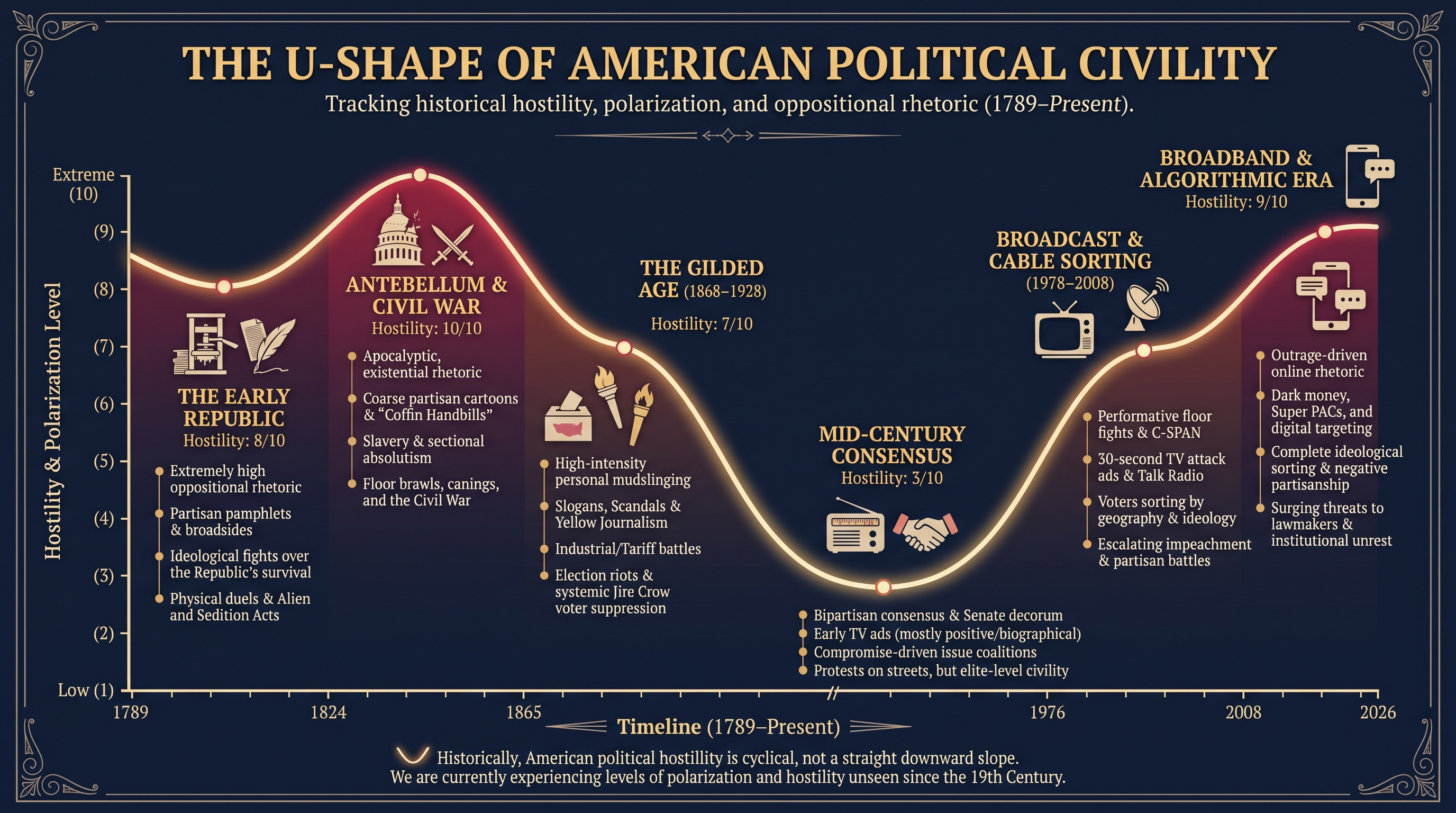
Uh-oh. If you just briefly look at the trendline, it appears that we are dangerously close to being at the least civil point in our nation's short history. This point in time runs almost parallel to the period during the Civil War, and we all know how that turned out... Anywho, let's take a closer look and see what else we can glean from this.
We (Google and I) decided to assign a point value to each of my aforementioned criteria, with 1 being the most civil and 10 being the most extreme and hostile. After establishing our rating criteria, Argon was kind enough to spit out an easily scannable spreadsheet with the raw scores. Since spreadsheets are super boring, I made (ahem, I mean asked, don't murder me, AI!) Argon dress it up a little bit.
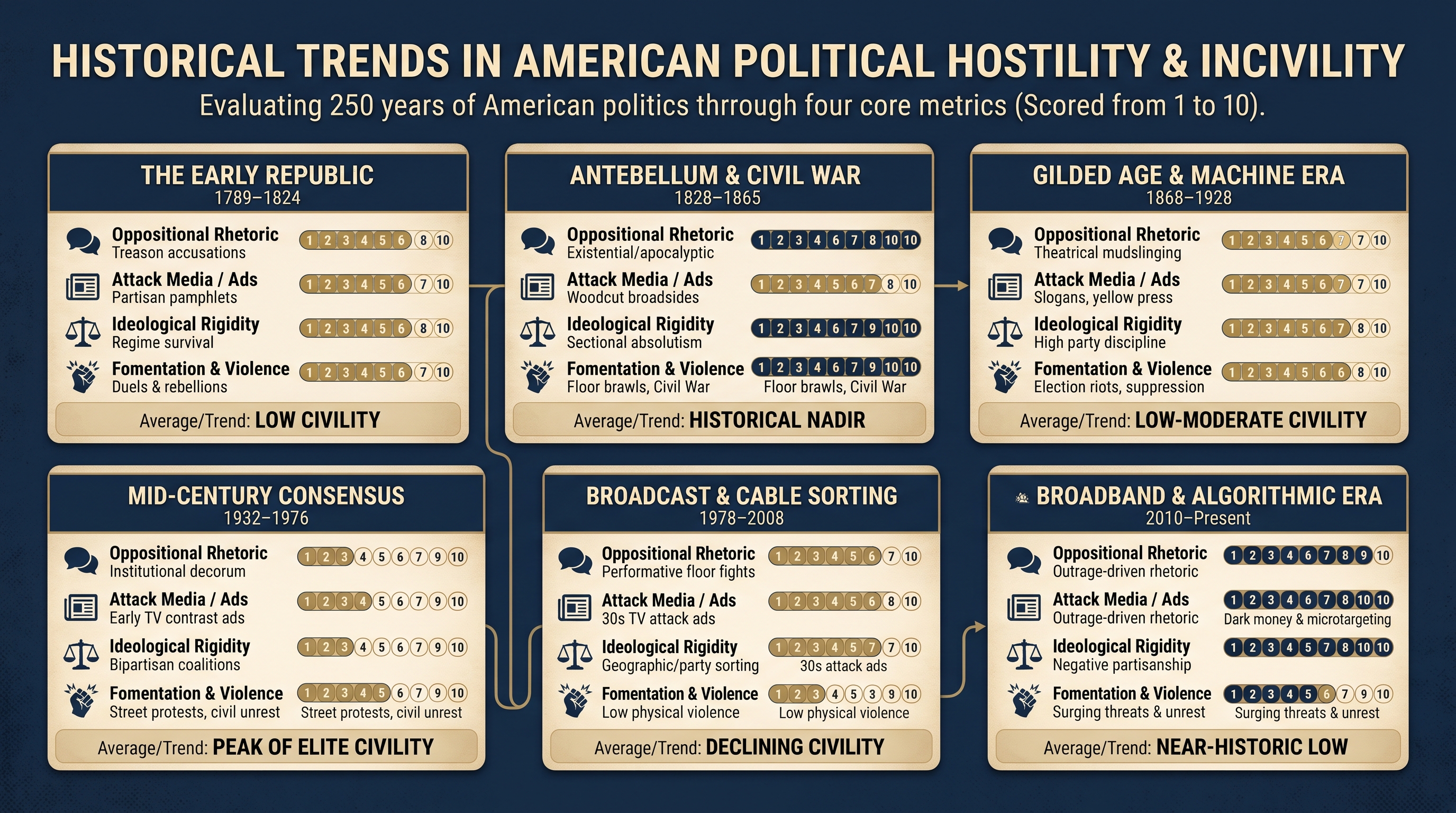
Looking at the data, there are some items that stand out: peak civility took hold in the decades following WWI. Why were politicians being so civil during huge calamities such as the Great Depression, WWII, Vietnam, and the many civil rights movements in between? What the heck! Those were some of the most tumultuous times in our history. Right? RIGHT? Why on Earth was there more civility in politics during some of the worst times ever? Well, a few reasons. I would also be remiss if I didn't point out that there were literal "floor brawls" during the Antebellum and Civil War eras. Fisticuffs!
A Few Reasons
The mid-twentieth century yielded great civility because of the abundant challenges facing the country during that time. One term that could be used is the concept of "rally around the flag." This means that people with a shared identity (when nationalism can be good) come together to combat a shared threat. Nothing unites people like catastrophe! In recent living memory, 9/11 was one of our modern rally-around-the-flag moments. Many people today harken back to that dark period of time and fondly reflect on how united we were as a country... unless you were Muslim, in which case people often attacked you out of fear.
Regardless of the desire of some to purge our Muslim citizens from the country, we were mostly united during that time because we had suffered what was perceived as a shared tragedy. It's not that everyone had a direct tie to the events of that day, but everyone shared in the horror, and most importantly, everyone saw it as an attack on America, not just a couple of giant buildings that fell down in a state far away from your own. People were attacking the United States, not just the World Trade Center, a Pennsylvania field, and the Pentagon. That distinction is important because a shared identity as the result of tragedy creates unity.
The period of the Greatest Generation featured some of the best unifying moments in our country's history. Remember the Great Depression, WWII, and Vietnam? Well, probably not unless you're over 100, but everyone has at least heard of these events. Almost all of these were major unifying happenings (though Washington's politeness back then also relied on kicking certain explosive issues down the road until the 1960s). I'll make a snap judgment in saying that even though Vietnam started during this period, it would also lead to this period's eventual demise due to the war's divisiveness back home. The political upheaval that resulted from this war ended up fracturing political alliances and drove division in Washington. Which leads me to our next reason: the ability of politicians to reach across the aisle to get things done.
The New Deal Coalition comes to mind when talking about cross-party associations. Lawmakers at the time couldn't afford polarization because of the grave economic impacts of the Great Depression, the very real military threats of WWII, and subsequently the realignment that happened after. They had no other choice but to work together or face inevitable destruction and decline. Again, this nods to the idea of rallying around the flag, but speaks specifically to politicians at the time and their willingness to work together regardless of party. Some of our greatest legislation was passed during this period: Social Security, massive infrastructure and civil projects, the SEC, the FDIC (federal insurance for the money that you hold in a bank), and the National Labor Relations Act (unions and workers' rights). Much of this legislation led to great American prosperity. The question now is, can we keep those prolific acts and services that we gained from the Greatest Generation? And where does that leave us today? Are there any good reasons for the divisiveness we're seeing now?
A Few More Reasons
I thought we had been maintaining the status quo when it comes to our current state of affairs. Vicious attack ads and ad hominem critiques often leave me wondering... what do these people actually believe in? There are few campaigns that I can recall that use an actual platform outside the two to three buzzwords intended to piss people off and get them to vote, because if you don't, you'll be faced with inevitable doom.
Politicians seem to focus on obscure subgroups of the population and then embellish or ignore the facts entirely to make their opponents appear to be the ruination of America.
"Trans people!" (Insert idiotic fear here, such as school sex changes.) "'Illegal' immigrants!" (Taking your jobs, killing your kids, and stealing your women! Insert obscure case to bolster claim.) "My opponent drinks wine and trips over kid gates!" Rabble, rabble, rabble.
Apparently, personal attack ads aren't exclusive to this generation of politics. All of this happened before in such wonderful times as the Civil War. That's the only period in time that directly correlates to this moment in history, and that's a bit scary if I'm being honest. So what makes the Civil War era mirror our current place in time? I would argue polarization is the largest culprit.
Remember earlier, during the golden age of political civility, when political parties would work together to find solutions to massive problems facing society? Right, I don't either, because that's beyond the bounds of my living memory. But that's what happened, and we ushered in the age of American prosperity as a result. Unfortunately, that prosperity has begun to wither due to a myriad of reasons, but the one we'll focus on now is fierce partisanship.
We are living in a hyper-polarized political system right now. Democrats and Republicans have become so entrenched along party lines that it's a legitimate rarity when they're able to work together. This mirrors division in the general population, as most people listen to their representatives and completely believe what they tell them. Ha ha, sorry. I know that was a poor joke. What people really do is filter for the things they like hearing from a certain candidate or politician because it validates their worldview, all the while ignoring larger-ticket items of governance that would prove detrimental. Single-issue voters and straight-ticket voters come to mind here.
Donald Trump is a master at this. He'll say something stupid, angry, basic, and slightly immoral, and people will cheer, thinking, "Wow, this guy talks like me! He talks a little rough, and I do too! He's for the little guy!" All of this is, of course, antithetical to who he actually is: a rich asshole who hasn't done any legitimate work in his entire life. This is again an example of voting against your interests. It's really weird to observe in real time.
Getting back to the point, extreme polarization is one of the main reasons for our departure from civility. You can't really be civil toward someone on the opposite side of the aisle; you have to foment hate toward them to maintain your voting base. We have departed from the issues and have gone back to feelings. Emotions can be much more powerful than logic. Emotions are also much more destructive, irrational, and, in the case of politics, divisive. If candidates were able to have disagreements but still come together, compromise, and move forward on issues for the good of the country, we'd be in a much better place.
I'm not a complete idiot. I know that issues like lobbying, greed, and outright corruption are all huge problems facing us today, but I still hold that genuine civility is a major issue in today's politics.
Riding That U-Shaped Halfpipe of Freedom
I would rightfully be asking myself what any of this means and whether we are headed for another civil war. Speaking to the latter sentiment, I would argue that we aren't. We are already seeing a transition away from divisive, hyperbolic political campaigns and a shift toward candidates who are actually pushing a platform. I would further argue that we are definitely at another crossroads in our nation's history that can lead to disaster or great change. It really is up to us, the voters, to make that change at the ballot box and elevate candidates who are actually good for the country instead of just getting angry at things we personally don't like but have nothing to do with the real issues.
If history has shown us anything, it's that all things are cyclical. If we are at or closely approaching another peak of hostility in our short history, that inevitably means there will be another fall. Hopefully, our giant horseshoe of hostility will become more of a wavelength, and we can carry on knowing better days are ahead. Let me know what you think about our current state of civility, or if I'm just an aging old man yelling at clouds. As always, thanks for reading.
Dad out.